
.png)
Promotional Gifting
10 Questions to Ask Before Choosing a Promotional Products Partner (Most Brands Skip #7)
Most promotional product orders go sideways for the same handful of reasons. The logo file was a JPEG. The brief didn’t mention a deadline. Nobody confirmed the Pantone code. The approval sat in someone’s inbox for a week.
None of these are the supplier’s fault. And none of them are your fault either — not really. They happen because there’s no structure to the conversation before the order is placed.
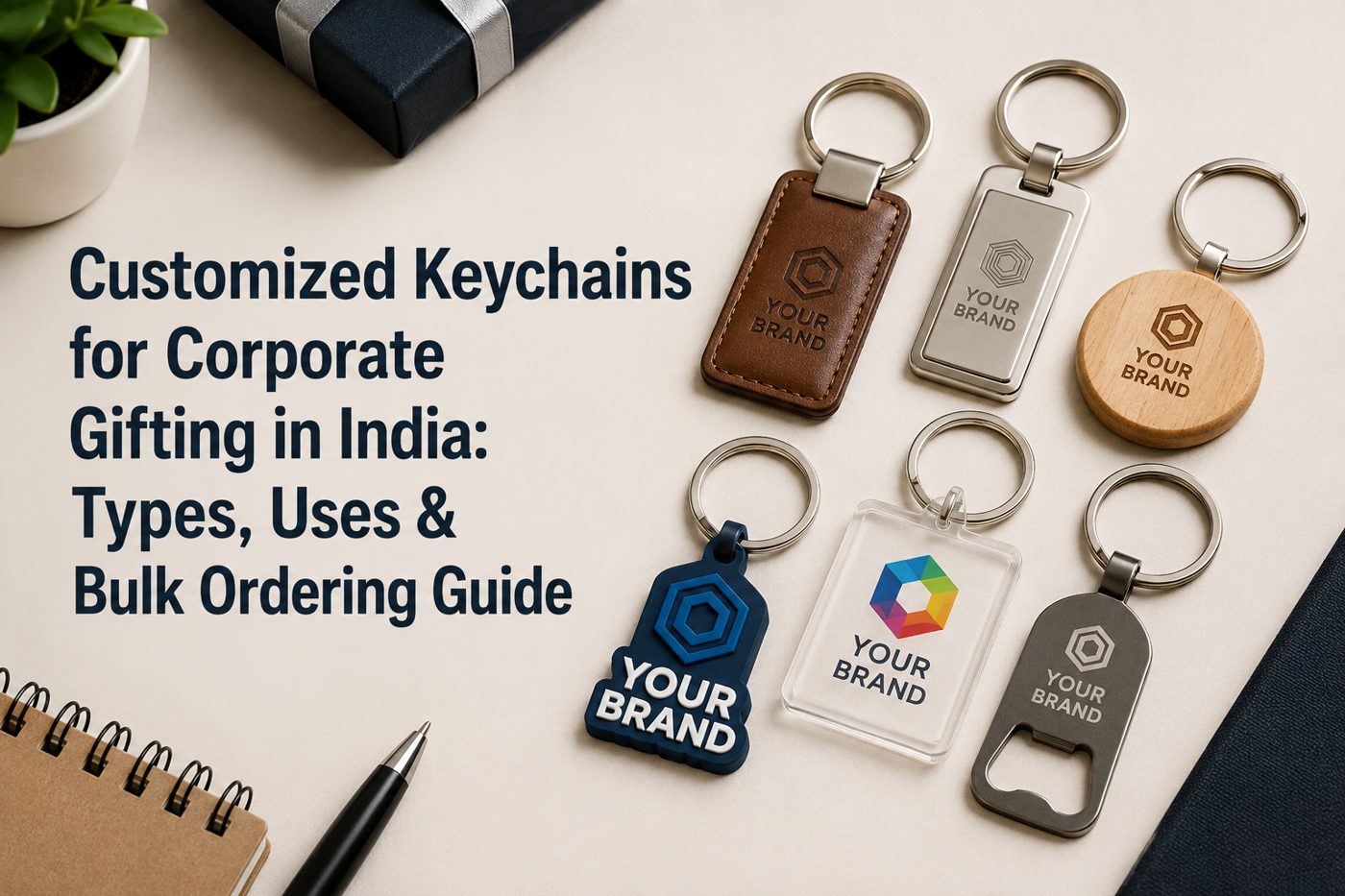
These 10 questions fix that. They’re what every buyer should ask — of their supplier and of themselves — before committing to a bulk run of custom key chains for business, branded pens, notebooks, or anything else with your logo on it. Work through them once, and you’ll save yourself at least one painful back-and-forth.
Q1. Do I have my logo in the right format?
WHY IT MATTERS
This is where more orders get delayed than anywhere else. If you send a JPEG or a PNG pulled from your website, your supplier has to redraw your logo from scratch — which takes time and introduces room for error. What you need is a vector file: a CDR, EPS, or SVG file that can be scaled to any size without losing quality.
If you don’t have one, ask your design team or agency. If you’ve never had a vector version made, a designer can create one from your existing logo in a few hours. It’s worth doing before you ever place a promotional order.
PRO TIP
Keep a “print-ready” folder with your vector logo, brand colour codes (Pantone and CMYK), and approved fonts. Share this with any supplier you work with regularly. You’ll save time on every order.
Q2. Do I know my exact brand colours — not just approximately?
WHY IT MATTERS
There’s your brand blue on screen, and then there’s your brand blue on a printed product. They are not the same thing. Screens display colour using light (RGB). Printing uses ink (CMYK or Pantone). If you only give your supplier a hex code, they’ll convert it as best they can — and it may come out noticeably different.
For anything where colour accuracy matters — a custom logo keyring, a branded pen, a diary cover — know your Pantone number. It’s the global standard for print colour matching, and it removes all ambiguity from the conversation.
Not sure what your Pantone codes are? Check your brand guidelines, ask your agency, or look at previous print orders. If no one knows, it’s worth finding out once and documenting it properly.
Q3. What is the actual deadline — and have I built in enough buffer?
WHY IT MATTERS
The event is on the 15th. You need products delivered to the venue by the 13th. Your supplier needs the order confirmed by the 1st to hit that. Which means you need to finish approvals by the 28th of the previous month. Which means you need to brief the supplier by the 22nd.
Work backwards from your hard deadline, not forwards from today. Most people do the opposite and then wonder why things are rushed.
For most bulk branded merchandise — rubber keychains, branded pens, notebooks — you should plan for a minimum of three to five weeks from artwork approval to delivery. Complex products or large volumes may take longer. At Kee Creation, our standard lead time is in that three-to-five week range; we’ll always tell you upfront if a specific order needs more.
PRO TIP
Add one week to whatever lead time your supplier quotes. Not because they’re unreliable — but because approvals, revisions, and dispatch logistics always take slightly longer than anyone expects.
Q4. Have I clearly defined where the logo goes and how big it should be?
WHY IT MATTERS
Placement and size are not details you should leave to interpretation. “Put the logo on the front” is not a brief. Is it centred? Top third? Bottom right? How much of the surface should it cover? Is there a tagline going with it?
A good supplier will send you a digital mockup showing exactly where the logo lands on the product before production begins. Review it carefully — on screen, the difference between 20mm and 30mm print size can look trivial, but on the actual product it’s the difference between a clear logo and one that’s either too small to read or overwhelming the product.
At Kee Creation, every order goes through a digital proof approval before we move to production. This is your moment to catch placement issues, not after the run is done.
Q5. What quantity do I actually need — and is it above the minimum?
WHY IT MATTERS
Promotional product manufacturing has a setup cost — creating moulds, preparing screens, mixing inks. That cost gets distributed across the units you order, which is why per-unit prices drop with volume and why manufacturers set minimum order quantities.
Before approaching a promotional products supplier in India, know your number. Not a range — a real number based on your distribution plan. If you’re gifting 200 people at an event, order 220. If you’re running a distributor programme for 800 outlets, order 900. Build in a small buffer for replacements, extras, and senior stakeholders who weren’t on the original list.
Our MOQ at Kee Creation is typically 500 units for most products. If your requirement is below that, it’s worth having an honest conversation upfront — we’ll tell you what’s feasible rather than take an order we can’t fulfil properly.
Q6. Do I know which product is right for this occasion and audience?
WHY IT MATTERS
The product choice should follow from the audience and occasion, not from what’s cheapest or most familiar. A rubber keychain is excellent for a high-volume trade activation with FMCG distributors — it’s durable, practical, and cost-effective at scale. It’s probably not the right call for a premium client appreciation gift.
Think about three things: who is receiving it, where will they use it, and how long do you want it to last? A quality metal keychain with laser engraving will outlast a rubber one by years. A hardbound diary and pen set signals investment in a relationship. A branded pen at a conference is a useful, unobtrusive reminder.
This is where working with a supplier who carries a broad range — rather than specialising in one or two products — genuinely helps. At Kee Creation we supply everything from rubber keychains and bottle openers to notebooks, diary sets, pen stands, and drinkware, which means we can recommend based on your brief rather than just what we happen to make.
Most buyers ask about price and delivery. Almost nobody asks this one — and it’s the question that separates a smooth order from a stressful one.
Q7. Who is my single point of contact, and how quickly do they respond?
WHY IT MATTERS
Promotional product orders involve multiple decisions — artwork approvals, material confirmation, quantity adjustments, delivery logistics. If you’re bouncing between different people at your supplier for each of these, things fall through the cracks. Fast.
Before you place an order, know exactly who you’re dealing with. One named contact. One number or email you can use for the life of the order. And a realistic sense of how quickly they respond — if approval turnarounds take 48 hours each, and you have three rounds of revisions, that’s almost a week of your lead time gone before production even starts.
This is something we hear consistently from clients who’ve worked with larger, less personal suppliers before reaching us. At Kee Creation, every client has a direct contact who handles their order end-to-end. It’s not a policy we advertise — it’s just how we work. For Procurement Managers juggling multiple vendor relationships, it makes a real difference.
PRO TIP
Test response time before you commit to a large order. Send an enquiry and see how long it takes to get a clear, specific reply. That response speed is what you’ll get throughout the order.
Q8. Have I confirmed delivery location, packaging, and who receives the shipment?
WHY IT MATTERS
Delivery logistics cause more last-minute panics than almost anything else. “Send it to our office” is not enough information. Your supplier needs: the complete delivery address with PIN code, the name of the person receiving it, a phone number for the courier, whether the products are being shipped as individual packs or a bulk carton, and whether there’s a time window for delivery.
If you’re shipping to multiple locations — regional offices, event venues, distributor addresses — provide a complete list upfront, not piecemeal as the deadline approaches. Pan-India delivery is something we handle regularly at Kee Creation, but we need clean address data to do it without delays.
Also think about packaging. Is the product going into a gifting box? Does it need individual wrapping? A branded bag or ribbon? Packaging isn’t an afterthought — it’s part of how the recipient experiences your brand. Confirm it at the briefing stage, not the day before dispatch.
Q9. Who internally needs to approve the artwork, and when can they do it?
WHY IT MATTERS
One of the most predictable causes of delay is internal approval bottlenecks. The supplier sends a digital proof. It lands in your inbox. You’re travelling. Or it needs sign-off from Marketing, who needs it from the Brand team, who are waiting on the MD.
Before you place the order, identify your approver and get a commitment from them. If the proof will need brand team sign-off, loop them in from the start — not after the supplier has already done three rounds of revisions. A 24-hour approval turnaround keeps your lead time intact. A 96-hour one quietly eats your buffer.
This is especially important for custom key chains for business gifting or any product where the logo appears in multiple colours or with additional text — the more elements in the artwork, the more there is to review, and the more critical a fast approval loop becomes.
Q10. Am I giving the supplier everything they need in one brief, or drip-feeding information?
WHY IT MATTERS
A complete brief at the start of an order is worth more than any amount of follow-up. When a supplier has to ask three separate questions over three separate days just to understand what you want, your lead time is already slipping.
A solid brief for any promotional product order covers:
- - Product type and any specific material/finish preferences
- - Quantity required
- - Logo file (vector format) and brand colour codes (Pantone/CMYK)
- - Logo placement and approximate print size
- - Delivery address(es) and required date
- - Packaging requirements, if any
- - Budget range, if relevant
You don’t need a formal document — a clear email covering these points is enough. The more complete your brief, the faster your supplier can turn around a proof, the fewer revision cycles you’ll need, and the more likely your order lands exactly when you need it.
How to Use This List
Run through these ten questions before you approach any supplier — not during the order, and definitely not after. Most of them take five minutes to answer. The ones that take longer (finding your vector logo, confirming your Pantone codes, getting an approval commitment from your brand team) are worth doing once properly rather than scrambling through every time.
A well-prepared buyer gets better results from every supplier they work with. Better pricing conversations, faster turnarounds, fewer revision cycles, and a final product that actually matches the brief. That’s not luck — it’s preparation.
The Bottom Line
The best promotional product orders are the ones where both sides know exactly what they’re doing before anyone touches a file or starts a machine. Your supplier brings manufacturing expertise, product knowledge, and design support. You bring a clear brief, the right assets, and a realistic timeline.
Get those two things aligned — on rubber keychains, branded pens, notebooks, or anything else — and the rest takes care of itself.
If you’re ready to place your next order and want to work with a team that will ask the right questions on their end too, let’s talk.
Frequently Asked Questions
What file format should I send to a promotional products supplier in India?
Always send a vector file — CDR(Corel Draw), EPS, or SVG. These formats can be scaled to any size without losing quality, which is essential for printing on physical products. If you only have a JPEG or PNG, your supplier will need to redraw the logo, which adds time and cost. Getting a proper vector file made once is worth the small investment.
What is the minimum order quantity for custom key chains for business in India?
MOQ varies by supplier and product type, but most manufacturers set a minimum of 500 units for customised keychains. Some products have lower MOQs, some higher. Always confirm before getting too far into a brief — if your quantity is below the minimum, the economics of the order change significantly.
How long does it take to get bulk branded merchandise made and delivered in India?
Three to five weeks is the standard range from artwork approval to delivery for most promotional products. This doesn’t include the time it takes to brief the supplier, get a proof, and complete internal approvals — which can add another one to two weeks if you’re not organised. For anything tied to a fixed event date, start the process six to eight weeks out.
Do I need to know my Pantone colour before ordering?
For colour-critical products — anything where logo colour accuracy matters — yes. Pantone is the industry standard for print colour matching. Without it, your supplier converts your RGB or hex colour to CMYK as best they can, and the result may be noticeably different from your screen colour. Check your brand guidelines or ask your agency for the Pantone reference.
What’s the most common mistake buyers make when ordering promotional products?
Ordering too late is the most common one. Everything else — wrong file format, vague brief, slow approvals — is fixable with time. Without enough lead time, none of those problems have a clean solution. The second most common mistake is not specifying logo placement and size clearly, which leads to revision cycles that eat into the production window.







.png)
.png)
.png)
.png)
.png)